(Matthew 5:31-32) Does God Really Expect Someone to Remain Married to an Abusive Spouse?
This article was updated with added material on 8/27/2026
“It hath been said, Whosoever shall put away his wife, let him give her a writing of divorcement: But I say unto you, That whosoever shall put away his wife, saving for the cause of fornication, causeth her to commit adultery: and whosoever shall marry her that is divorced committeth adultery.” (Matthew 5:31-32; King James Version)
 Some have concluded by reading these words from Jesus that the ONLY valid reason for a couple to get a divorce is if one has committed fornication (or sexual immorality) which most often is explained as being adultery. It is then taught if a married couple gets a divorce for any other reason, they cannot remarry someone else or they will be condemned as an adulterer. Even if the spouse is physically abusive to his/her partner it is taught they cannot legally get a divorce in God’s eyes. Instead, the abused party can only separate but is still forbidden to remarry anyone else unless the abusive spouse dies.
Over the years of his ministry, in several sermons and Q&A sessions, Pastor John MacArthur has repeatedly taught, “You don't have grounds for divorce simply because your husband is abusive” (Grace to You Q&A on Divorce and Abuse). In fact, back in 2002, Grace Community Church, under John MacArthur, publicly disciplined Eileen Gray after she separated from her husband, who was later convicted of abusing both her and their children. During the church announcement, she was described as “...refusing to acknowledge her sin of leaving her husband...” The church urged her to reconcile with him before his criminal convictions became known publicly. This incident has been documented through church recordings, court filings, and investigative reporting.
Others, like Bill Gothard, have taught abused spouses, “God may allow abuse in your life to develop Christlike character” (Institute in Basic Life Principles [IBLP], Seminars and Counseling Materials, Basic Seminar Workbook, ATI Counseling Materials). In other words, “Keep submitting to your sinful abusive husband ladies, and soon you will develop that Christlike character you desire!” What a shame.
Furthermore, the man-made proverb that says, “God is more concerned with your holiness than your happiness", was made popular by many independent Baptist and conservative evangelical counseling books. This principle was frequently applied to abusive marriages by encouraging wives to remain faithful while praying for God to change their husbands.
And what about abusive wives? Is the abused husband bound to stay married as well? Is this what Jesus is really implying when He says, “except for the cause of sexual immorality”? Is He teaching, “If you divorce your husband/wife because they are abusive, you will become an adulterer if you marry someone else?” Is this really the character of our loving heavenly Father? Does He really demand someone who has escaped his or her abusive spouse to remain married (but separate) and to live alone without the possibility of finding someone else who will love and care for them until the abuser dies? In order to truly understand what God says concerning this issue, we must do a brief study of what Scripture truly says concerning marriage, divorce and remarriage.
To “Put Away” is Different than “Divorce”
When Jesus says, “Whosoever shall put away his wife”, Matthew uses the Greek word ἀπολύω (apoluó) for “put away”. However, when Jesus says, “let him give her a writing of divorcement”, Matthew uses the Greek word ἀποστάσιον (apostasion) for the word, “divorcement”. As we will clearly see, the “divorcement” and the “putting away” are two separate things. At the end of Jesus’ instruction, the KJV reads, “whosoever shall marry her that is divorced committeth adultery.” However, the Greek word here is apoluó or “put away”. Although most Bible translations use the word “divorce” here, the World English Bible translates it correctly:
“It was also said, ‘Whoever shall put away [apoluó] his wife, let him give her a writing of divorce [apostasion],’ but I tell you that whoever puts away [apoluó] his wife, except for the cause of sexual immorality, makes her an adulteress; and whoever marries her when she is put away [apoluó] commits adultery.”
The Berean Standard Bible has that last sentence as: “he who marries a divorced woman commits adultery.” However, in the Berean Literal Bible it says: “whoever shall marry her who has been sent away, he commits adultery.”
In fact, the American Standard Version, which is a revision of the KJV published in 1901, reads this way:
“It was said also, Whosoever shall put away [apoluó] his wife, let him give her a writing of divorcement [apostasion]: but I say unto you, that every one that putteth away [apoluó] his wife, saving for the cause of fornication, maketh her an adulteress: and whosoever shall marry her when she is put away [apoluó] committeth adultery.”
Now, take note that Jesus begins by saying, “It has been said”, thus, what Jesus is saying has already been said before. Jesus is actually referring to the Law (i.e., Instruction) concerning divorce found in Deuteronomy chapter 24:
“When a man hath taken a wife, and married her, and it come to pass that she find no favour in his eyes, because he hath found some uncleanness in her: then let him write her a bill of divorcement, and give it in her hand, and send her out of his house. And when she is departed out of his house, she may go and be another man's wife.” (Deuteronomy 24:1-2; KJV)
Here we clearly see that it is lawful for a divorced person to remarry. In verses 3-4, God gives additional instructions:
“And if the latter husband hate her, and write her a bill of divorcement, and giveth it in her hand, and sendeth her out of his house; or if the latter husband die, which took her to be his wife; Her former husband, which sent her away, may not take her again to be his wife, after that she is defiled; for that is abomination before the LORD: and thou shalt not cause the land to sin, which the LORD thy God giveth thee for an inheritance.”
All this is saying is that, if the second husband divorces the woman, the first husband cannot marry her again. Although we will not be discussing the details as to why this is in this article, take note that here in the Law we clearly see that remarriage is not forbidden except if it is to your former spouse after being remarried to someone else.
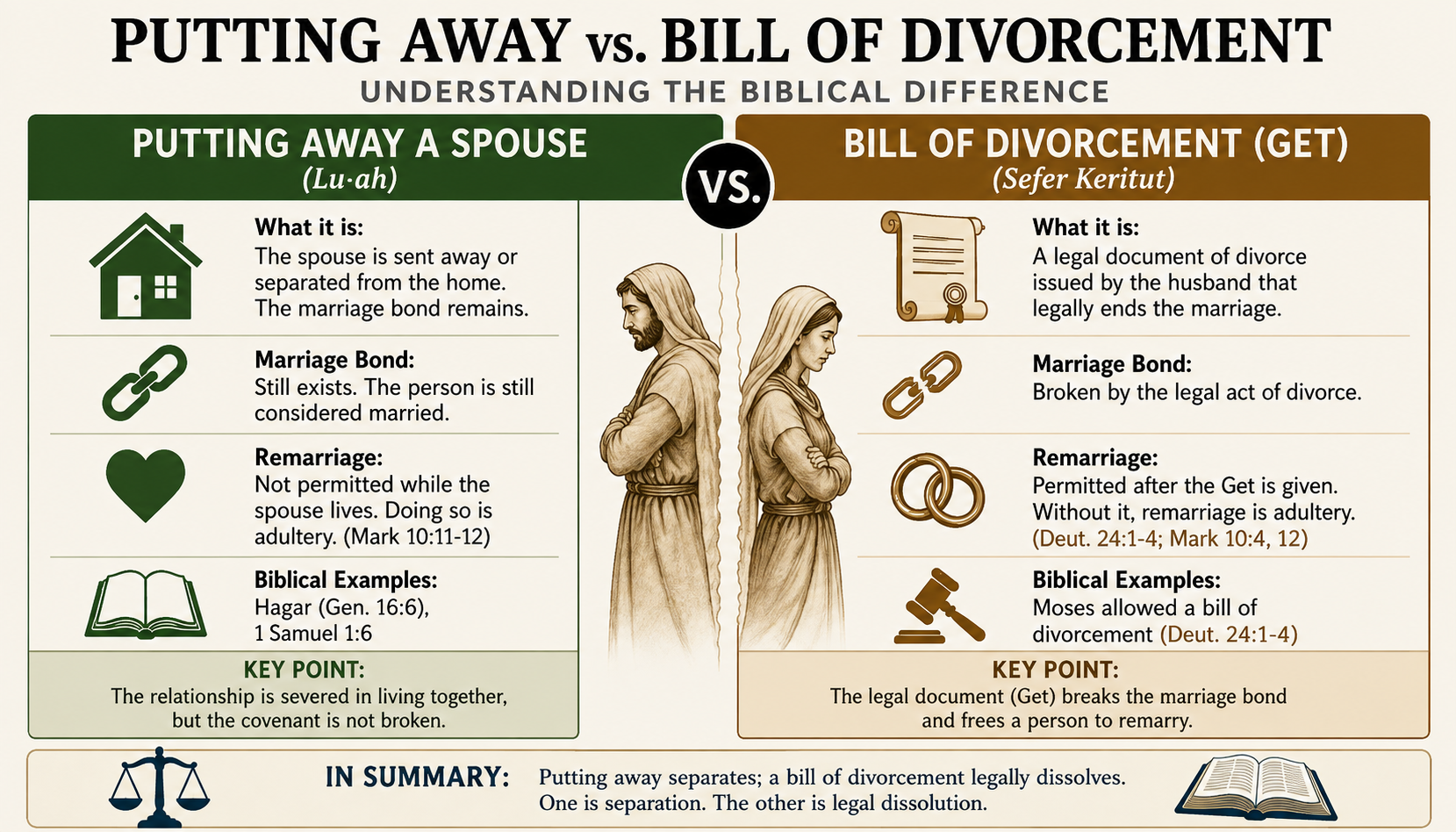
Let’s zoom in on some Hebrew words used. Three times the word “send” or “sent” is used in verses 1-4. The Hebrew word here is שָׁלַח (shalach). This is the Hebrew equivalent to the Greek word apoluó (put away, send, loose). Twice the word “divorcement” is used, which is the Hebrew word, כְּרִיתוּת (kriythuwth), which is the Hebrew equivalent to the Greek word apostasion (divorce, cut off). In this scenario, God is using the example of a man sending away his wife. His instruction is for the man to give her a bill of divorcement so that she may go and be another man’s wife. In other words, do not just send (put) her away (shalach/apoluó); he must give her a bill of divorcement (kriythuwth/apostasion), otherwise the woman would not be able to go and be another man’s wife. The bill of divorcement gives the former spouse the right to remarry, it does not hinder it. It is only if the spouse does not have the bill of divorcement that they are not permitted to remarry.
Man’s Hardheartedness
In Matthew chapter 19, we read about an encounter Jesus had with the Pharisees concerning the issue of putting away a wife:
“The Pharisees also came unto Him [Jesus], tempting Him, and saying unto Him, Is it lawful for a man to put away [apoluó] his wife for every cause? And He answered and said unto them, Have ye not read, that he which made them at the beginning made them male and female, And said, For this cause shall a man leave father and mother, and shall cleave to his wife: and they twain shall be one flesh? Wherefore they are no more twain, but one flesh. What therefore God hath joined together, let not man put asunder. They say unto Him, Why did Moses then command to give a writing of divorcement, [apostasion] and to put her away [apoluó]? He saith unto them, Moses because of the hardness of your hearts suffered you to put away [apoluó] your wives: but from the beginning it was not so. And I say unto you, Whosoever shall put away [apoluó] his wife, except it be for fornication, and shall marry another, committeth adultery: and whoso marrieth her which is put away [apoluó] doth commit adultery.” (Matthew 19:3-9)
In every instance here, the KJV correctly translates the Greek word apoluó as “put away” (or send away). Other translations insert the word “divorce” in some of those instances, which has caused confusion on the issue at hand.
Take note that Jesus says it was due to the man’s hardheartedness that God, through Moses, permitted them to “put away” their wives. However, according to the original Instruction found in Deuteronomy 24, they were not permitted to put away their wives without a bill of divorcement. What was happening was the man became so hardhearted against his wife that he would send her away without giving her a bill of divorcement so she could not remarry another man. This happens even today among the Jewish culture. Even if the man is abusive, if he does not give the woman a bill of divorcement (if she does not physically have it in her possession), she is not permitted to remarry. In Judaism today this is called “a Get”, which is an Aramaic word short for “bill of divorcement” adopted during the Talmudic period. It specifically refers to a writ of divorce handed from a husband to his wife to legally dissolve their marriage.
“A Get is a religious document under Jewish law (Halakha) that officially dissolves a Jewish marriage. It must be willingly initiated by the husband, accepted by the wife, and executed before a rabbinical court to be valid. Without it, the marriage is still recognized, which prevents the couple from securely remarrying within traditional Jewish law.
Core Principles and Rules
- Willing Consent: For the Get to be valid, the husband must give it of his own free will, and the wife must willingly accept it.
- The Document: The Get is traditionally written in Aramaic by a qualified scribe (sofer) using a special quill and ink. It typically spans exactly 12 lines and is carefully tailored to the specific names and locations of the couple.
- No-Fault Nature: The document does not assign blame or state reasons for the divorce. Its central declaration is simply, ‘You are hereby permitted to all men,’ legally severing the marital bond.
Procedural Requirements: The process requires the presence of three rabbis (Beis Din) and two competent witnesses. The husband drops the scroll into the cupped hands of his wife. If the couple cannot be in the same room, a trusted agent can be appointed to deliver the document.
Why the Get Matters
- Civil vs. Religious Divorce: In Orthodox and Conservative Judaism, a secular or civil divorce does not terminate the religious marriage. A couple must receive the Get [a specific religious divorce document] physically in order to be free to remarry.
- Agunah (‘Chained Woman’): If a husband refuses to grant a Get, the woman is legally ‘chained’ and cannot remarry in accordance with Jewish law.
- Children's Status: Under strict interpretation, if a married woman has a child with another man prior to receiving a Get, that child is considered mamzer (illegitimate) and faces restrictions on marrying within the Jewish community” (AI Overview)
It was to remedy those last three points (the hardheartedness of the man) why God commanded the man to give a bill of divorcement into her hand. But some may interject here to say, “No, no, Jesus says God PERMITTED it; He did not COMMAND it.” Truly, Matthew quotes Jesus as saying, “Moses, on account of the hardness of your hearts, permitted you to put away your wives” (Matthew 19:8). However, what some seem to overlook is the fact that when Mark quotes Jesus, he writes, “On account of the hardness of your hearts, he wrote this commandment for you” (Mark 10:5). In fact, the whole conversation with the Pharisees is the exact opposite when you compare the two accounts:
Matthew 19:7-8: “They [Pharisees] said to him: Why, then, did Moses command us to give a bill of divorce and put her away? He [Jesus] said to them: Moses, on account of the hardness of your hearts, permitted you to put away your wives; but from the beginning it was not so.”
Mark 10:4-5: “They [the Pharisees] replied: Moses permitted us to write a bill of divorce, and put her away. And Jesus answered and said to them: On account of the hardness of your hearts, he wrote this commandment for you.”
The bill of divorcement wasn’t to stop the woman from remarrying, but to free her to do so! The bill of divorcement was meant to PROTECT the woman being put away from hardhearted men. Again, the bill of divorcement wasn’t meant to prevent remarriage; it was given in order to permit remarriage! Once the bill of divorcement is in the woman’s possession, it legally severs the marital bond, and she is permitted to remarry.
“What Moses did in the law, and that God permitted, was recognize that in a fallen world, marriages sometimes fail. Even though it is not the perfect-world scenario; it is a real-world situation. The Law of Moses, also known as the Law of God, regulated how to best treat the tragic break up of marriage. Marriage was instituted in a world without sin. But God recognized that Moses was dealing with marriage in a world of sin. Marriage in a world free of sin will last forever; marriage in a world with sin is going to require a redemptive response. What God gave to man in his law to Moses was a plan B to redeem and restore marriage. The reason God allowed for remarriage is not because God is pro-divorce, but because God is pro-marriage and pro-family … One of the redemptive things about the divorce law of Deuteronomy 24 was that it was protective for women … putting away is a separate (but related) action from giving a bill of divorce. The Law of Moses disallowed men from sending their wives away without a bill of divorce. By just putting them away, they did not have to return their dowry and the woman could not marry anyone else. So, the mandatory bill of divorce freed the woman to marry someone else so that she could have a life. Once again, we see God being pro-marriage and pro-family.” (John C. Carroll, An Introduction to Divorce & Remarriage, A Biblical Theology of Healing after Heartbreak, p. 112)
Does God Hate Divorce?
In many translations of the Bible, Malachi 2:16 quotes God as saying, “I hate divorce!” However, the Hebrew word here is shalach (put away). Although divorce is not God’s ideal, He instructed (commanded) it to be done in order to protect the woman. Therefore, what God hates more than a married couple who get divorced is when the man puts his wife away, treating her as his property without any support because he has not given her a bill of divorcement! In this scenario, if a husband was abusive to his wife (either emotionally, physically, sexually etc.) he is still being abusive to her even though they are now separated.
“Today … many agunot [chained women] find themselves ‘chained’ by husbands who refuse to give them a get [bill of divorcement]. This refusal to give a get is a common form of spousal abuse, a way to keep power and control over a woman and prevent her from moving on with her life. Often a man abuses his power by refusing to give a get unless his wife agrees to give him custody of their children, money, or something else that he wants. Being an agunah [chained woman] can create real hardship and sorrow for a woman, her children, and for her friends and family. As an agunah, she is unable to remarry and have full control over her own life decisions. For Orthodox women especially, whose identity is often tied to being a wife and mother, the inability to remarry and perhaps have children can make her feel as if she has lost her identity.” (womenslaw.org/jewish-community)
In fact, Jewish women can receive support and advocacy to obtain a religious divorce document (Get) through specialized organizations like the Organization for the Resolution of Agunot (ORA), the Beth Din of America, and Kayama. These groups assist with rabbinical court navigation and handling refusal cases.
In verses 14 and 15 of Malachi 2, we find more context and see that God is rebuking the men who dealt “treacherously” against their wives by putting them away without a bill of divorcement. This is why God says, “I hate putting away” in verse 16. However, according to the Law in Deuteronomy 24, we know it is not dealing treacherously when a man gives her a bill of divorcement when he puts her away. This is exactly what God did with unfaithful Israel, “I had put her away [shalach], and given her a bill of divorcement [kriythuwth]” (Jeremiah 3:8). The men of Malachi 2 were being treacherous (unfaithful, deceitful, abusive) against their wives, God was not!
Please remember we are dealing with the Jewish culture of the day, and God is simply working through this culture as carefully and lovingly as He can (just as He does today with us). In that culture, the man was the sole provider of the family in the sense that he would provide the food to be cooked and the material for shelter and clothing to be made. On top of this, he was not to withhold sexual relations from his wife. However, women were being “put away” without any support and they could not remarry another man who desired to truly love and cherish her and provide all these provisions for her unless she was given a bill of divorcement. This bill of divorcement was her proof that she was divorced and had the legal right to remarry, shutting down any accusations from others claiming she was committing adultery (which she would have been if she did not possess the bill of divorcement). In this light, God commanded divorce in His Law as an act of MERCY!
“Women were ‘put away’ when their men married others, put away to be available if needed or wanted again, put away to become mere property, as slaves, or put away in total dismissal; it was a cruel day for women. They were put away in favor of another, but not given a divorce and the right to remarry again.” (Walter L. Callison, Divorce, the Law and Jesus, p. 3)
This also works the other way around if a woman chooses to put her husband away without a bill of divorcement:
“And he saith unto them, Whosoever shall put away [apoluó] his wife, and marry another, committeth adultery against her. And if a woman shall put away [apoluó] her husband, and be married to another, she committeth adultery.” (Mark 10:11-12)
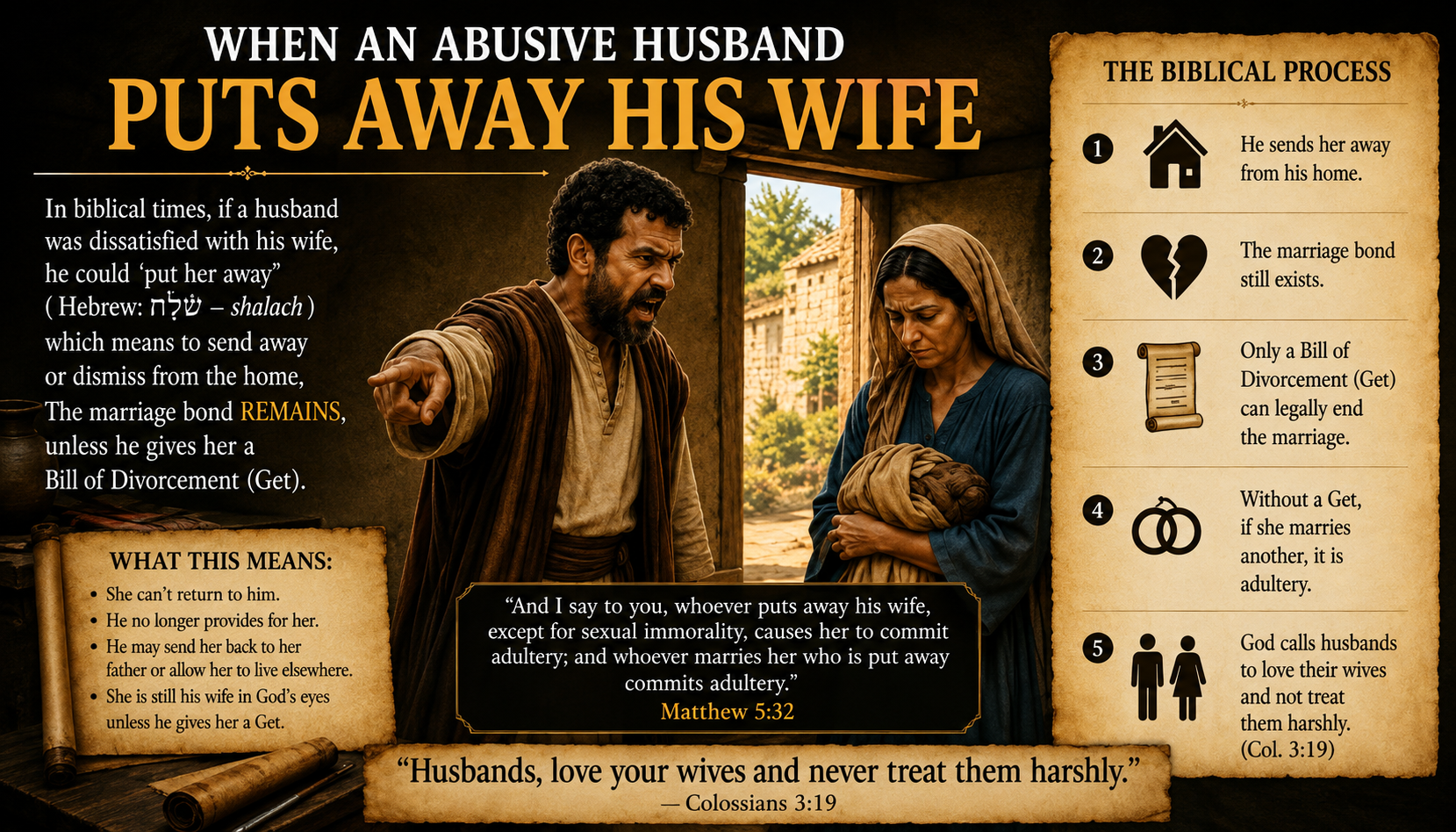
In other cultures (especially in the West) an official Rabbinic Get isn’t necessary because the actual bill of divorcement is sufficient. Being written in Aramaic by a qualified scribe using a special quill and ink, spanning exactly 12 lines, and requiring the presence of three rabbis is all added man-made tradition. Once the two parties are handed the official divorce papers, both parties are free to remarry. This is important because there are Bible teachers today who wrongly teach that, even if you are legally divorced, you still cannot remarry but this is the exact opposite of what God’s Law states.
Can Divorce Be For Any Reason?
Going back to Matthew 19:9, we saw that Jesus said:
“And I say unto you, Whosoever shall put away his wife, except it be for fornication, and shall marry another, committeth adultery: and whoso marrieth her which is put away doth commit adultery.”
Many have concluded that the only reason Jesus gives for a married couple to divorce is due to “fornication” or πορνεία (porneia). Most other versions say, “sexual immorality.” First of all, when saying this, Jesus is answering the Pharisees’ question, “Is it lawful for a man to put away his wife for any cause?” (Verse 3). The topic at hand is the putting away phase, not the divorce, although other translations may use the word “divorce” such as the New Living Translation: “Should a man be allowed to divorce his wife for just any reason?”
This question stems from an actual debate among Jewish leaders that had been brewing. The debate is over the wording found back in Deuteronomy 24:1 where the KJV says:
“When a man hath taken a wife, and married her, and it come to pass that she find no favour in his eyes, because he hath found some uncleanness in her …”
Other translations say:
New International Version: “… because he finds something indecent about her …”
New Living Translation: “… Having discovered something wrong with her …”
Amplified Bible: “… because he has found something indecent or unacceptable about her …”
The Hebrew word in question is עֶרְוָה (ervah) and is most commonly defined as “nakedness, undefended parts, bare” which led a prominent Hebrew Rabbi named Shammai (known to be strict and judgmental) to teach that this word only refers to sexual immorality. Opposite his view was Rabbi Hillel (known to advocate for peace, empathy, and the pursuit of justice, emphasizing understanding others’ perspectives before judgment) who taught this word, even in the marriage setting, could be understood as “for any reason”, even if the wife was a bad cook for example. The Jewish Talmud summarizes the lasting historical impression of both men into a single maxim for future generations:
“A person should always be patient like Hillel, and a person should not be strict like Shammai.” (Babylonian Talmud, Shabbat 30b)
The following famous Talmudic story, found in Babylonian Talmud, Shabbat 31a, demonstrates how the two sages reacted to provocations and tests of their patience:
“A certain gentile came before Shammai and said to him: ‘Convert me on condition that you teach me the entire Torah while I am standing on one foot.’ Shammai pushed him away with the builder's measuring rod that was in his hand. The same gentile came before Hillel. Hillel converted him and said to him: ‘What is hateful to you, do not do to your neighbor. That is the whole Torah; the rest is the explanation; go and study.’”

Because Rabbi Shamai believed ervah refers only to sexual immorality, most people assume Jesus sided with the House of Shammai when He said, “except for sexual immorality” or, in their view, only if the spouse commits adultery.
However, to further understand this, we again need to look at the original Instruction found in Deuteronomy 24, keeping in mind that Jesus would have never spoke contrary to it (Matthew 5:17-19). As previously noted, the Hebrew word in question is ervah, which often times is translated “nakedness.” However, it doesn’t always refer to sexual relations. Referring to Deuteronomy 24:1, the Topical Lexicon says, “Here עֶרְוָה broadens to any disgrace undermining the marriage covenant, yet still tied to moral exposure.”
In Exodus 20:26 and Exodus 28:42 it specifically speaks of one’s personal nakedness without anything to do with sex. Likewise, in Genesis 42:9 the word refers to the land of Canaan during the time of famine. Here’s a few Translations of Genesis 42:9:
King James Version: “Ye are spies; to see the nakedness of the land ye are come.”
New International Version: “You have come to see where our land is unprotected.”
New Living Translation: “You have come to see how vulnerable our land has become.”
Christian Standard Bible: “You have come to see the weakness of the land.”
Contemporary English Version: “You've come here to find out where our country is weak."
In Deuteronomy 23:14 (the chapter right before the Law concerning divorce) ervah is used for “anything indecent” (NIV); “any shameful thing” (NLT); “anything unclean” (BSB); “anything improper” (HCSB); “something disgusting” (CEV); “anything offensive” (GWT). And again, the context is not referring to sex, but says:
“Each of you must have a spade as part of your equipment. Whenever you relieve yourself, dig a hole with the spade and cover the excrement. The camp must be holy, for the LORD your God moves around in your camp to protect you and to defeat your enemies. He must not see any shameful thing [ervah] among you, or he will turn away from you.” (Deuteronomy 23:13-14, NLT)
Therefore, in the Law concerning Divorce, God is speaking about “anything offensive, shameful, unclean, disgusting etc. that the man finds in his wife. Take a look at what the famous historian Flavius Josephus (living in the 1st century AD) writes concerning this as he summarizes God’s Law regarding divorce from Deuteronomy 24:
“He that desires to be divorced from his wife for any cause whatsoever, (and many such causes happen among men,) let him in writing give assurance that he will never use her as his wife any more; for by this means she may be at liberty to marry another husband, although before this bill of divorce be given, she is not to be permitted so to do: but if she be misused by him also, or if, when he is dead, her first husband would marry her again, it shall not be lawful for her to return to him.” (Antiquities of the Jews, The Life and Work of Flavius Josephus, Book 4, Ch. 8, Sec. 23, p. 134, translated by William Whiston, 1737)
This does NOT mean that God was condoning such behavior. It’s not God’s ideal that a married couple become hardhearted towards each other. Obviously, God does not condone a man putting away his wife simply because she’s a bad cook. However, this does take place, and God’s Law gives righteous Instructions on how to move forward if the couple cannot be reconciled. Divorcing is not a sin, but it is a sin to put away your spouse without giving him/her a bill of divorcement! If divorce was a sin, then God committed a sin when He divorced Israel (Jeremiah 3:8).
“Except for Sexual Immorality”?
Now let’s look closer at Jesus’ words where He says, “whoever shall send away his wife, except for sexual immorality, and shall marry another, he commits adultery” (Berean Literal Bible). First of all, let’s temporarily take away the phrase in question:
“Whoever shall send away his wife … and shall marry another, he commits adultery.”
This is actually how Mark records Jesus’ words (Mark 10:11), but we will come back to that in a bit. For now, let’s focus on the fact that the topic is the sending away phase, NOT the divorce. If a man puts His wife away without a bill of divorcement, neither he nor his wife can remarry. However, the exception here is if there was any sexual immorality. In other words, the man could put away his wife without a bill of divorcement if she was found to be an adulterer. Why? Because the punishment for adultery (if witnessed by two or more witnesses and proven in court, Deuteronomy 17:6; 19:15) was death, both to the woman/man and the man/woman whom she/he committed adultery with (Leviticus 20:10; Deuteronomy 22:22). The punishment was not that she/he couldn’t remarry, but death. If the spouse had a forgiving heart, as God did towards Israel, they could give a bill of divorcement and send the guilty party away, and they would be free to remarry. Why? Because they would no longer be husband and wife.
Furthermore, Jesus’ “sexual immorality” exception does not only apply to adultery as we know it. There were a number of things God described as sexually immoral. For example, Leviticus 20:21 prohibits marrying a woman and her daughter or granddaughter. Deuteronomy 27:20–23 lists incestuous unions as forbidden by the Law. In Leviticus 18, God forbids any sexual relations with a mother, father’s wife, sister (father’s or mother’s daughter), granddaughter, father’s wife’s daughter, father’s sister, mother’s sister, father’s brother’s wife, daughter-in-law, and brother’s wife, or any relations between the same sex. Paul specifically calls this type of sexual immorality “fornication”:
“It is reported commonly that there is fornication [porneia] among you … that one should have his father's wife.” (1 Corinthians 5:1)
Referring to the Instructions found in Leviticus 17 and 18, James tells Gentile believers: “That they abstain from pollutions of idols, and from fornication [porneia], and from things strangled, and from blood” (Acts 15:19-20).
When dealing with these sexual immoralities, there is no need for a bill of divorcement in God’s eyes. For example, if two men get married, but later one of them repents, it would be lawful to put away the other man without a bill of divorcement. Why? Because they were never married in God’s eyes. The other man was NEVER truly his husband; instead, they were committing sexual immorality. Now of course, in this scenario, the civil laws of the land would also be at play so they would still need to follow the proper divorce procedures of that government.
God’s people were also warned not to marry idol-worshippers from foreign lands; the exception being if the foreigner converts and embraces God’s covenant. In fact, Paul counsels that “if the husband or wife who isn’t a believer insists on leaving, let them go. In such cases the believing husband or wife is no longer bound to the other, for God has called you to live in peace” (1 Corinthians 7:16, NLT).
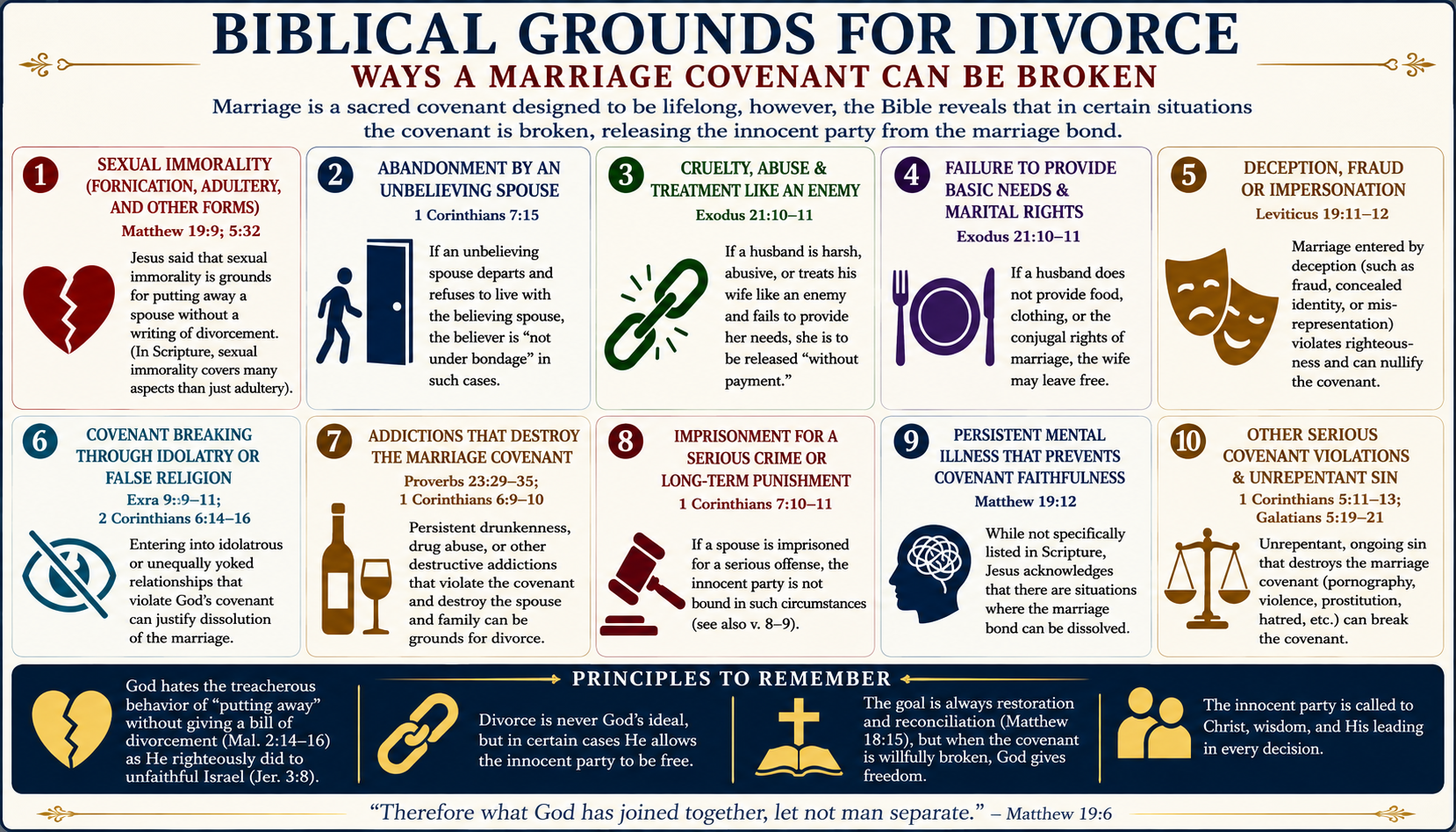
In the context of a man having multiple wives (which God never condoned but reluctantly accommodated) we read that God’s Law permits a wife to leave if her husband does not fulfill his duties to provide food, shelter, clothing and denies the wife’s rights to have sexual relations with him.
“If that son marries another woman, he must not deprive the first wife of food, clothes, or sex. If he doesn't give her these three things, she can go free, without paying any money for her freedom.” (Exodus 21:9-10, God’s Word Translation)
In fact, Paul instructs both the wife and the husband not to withhold sexual relations from each other (1 Corinthians 7:5). In other words, it would be immoral to do so. Therefore, like the woman in Exodus 21, a man could also lawfully leave his wife if she withholds sexual relations from him.
Furthermore, right in Matthew 5 Jesus said this:
“You have heard that it was said, ‘Do not commit adultery.’ But I tell you that anyone who looks at a woman lustfully has already committed adultery with her in his heart.” (Matthew 5:27-28)
One does not need to have physical sex in order to be an adulterer. Adultery is a matter of the heart; “For out of the heart proceed evil thoughts, murders, adulteries, fornications, thefts, false witness, blasphemies” (Matthew 15:19). When we betray our spouse in heart, we commit adultery (and fornication), and this can take many forms. For example, notice what God says in the book of Jeremiah:
“‘Oh, that I could go away and forget My people and live in a travelers’ shack in the desert. For they are all adulterers— a pack of treacherous liars. Judgment for Disobedience My people bend their tongues like bows to shoot out lies. They refuse to stand up for the truth. They only go from bad to worse. They do not know me,” says the LORD.” (Jeremiah 9:2-3, NLT)
Here we see that an adulterer is defined as someone who bends their tongue like a bow to shoot out lies. There’s nothing here about sexual relations. It is a matter of the heart of an unfaithful person.
And James wrote:
“Adulterers and adulteresses! Do you not know that friendship with the world is enmity with God? Whoever therefore wants to be a friend of the world makes himself an enemy of God.” (James 4:4)
Again, adultery is a matter of the heart as we become “lovers of pleasure rather than lovers of God” (2 Timothy 3:4). And this “pleasure” James refers to is not specifically speaking about sexual pleasure (see full context of 2 Timothy 3:1-5).
“Can unfaithfulness be revealed by sex with another? Absolutely. But is sex with another the only way to reveal unfaithfulness? No. And this is the mistaken idea many cling to when dealing with this issue. Would a wife who tries to murder her husband be guilty of unfaithfulness? Would this constitute ‘Biblical’ grounds for divorce? Listen to what James says:
For whoever keeps the whole law and yet stumbles at just one point is guilty of breaking all of it. For he who said, ‘Do not commit adultery,’ also said, ‘Do not murder.’ If you do not commit adultery but do commit murder, you have become a lawbreaker. James 2:10,11
Would the person who tries to murder their spouse be a lawbreaker? Is it a different law or the same law as committing sexual adultery? And what is that law?
Jesus replied: ‘Love the Lord your God with all your heart and with all your soul and with all your mind.’ This is the first and greatest commandment. And the second is like it: ‘Love your neighbor as yourself.’ All the Law and the Prophets hang on these two commandments. Matthew 22:37-40
Therefore love is the fulfillment of the law. Romans 13:10
If you really keep the royal law found in Scripture, ‘Love your neighbor as yourself,’ you are doing right. James 2:8
The law of God is the law of love. Marriage is designed by God to be the place where finite beings enter, as closely as possible, to the perfect love of God … Any spouse whose heart is against their partner, whose heart is closed, hardened and cold, who would exploit, dominate, control, take advantage, and who remains unrepentant, calloused and cruel, regardless of sexual contact, is unfaithful to his or her marriage covenant.” (DR. Timothy Jennings, Marriage, Divorce and Remarriage, comeandreason.com)
In Colossians 3, Paul councils married couples by saying, “Wives, submit to your husbands, as is fitting for those who belong to the Lord. Husbands, love your wives and never treat them harshly” (Colossians 3:18-19). In his letter to the Ephesian assembly, Paul wrote:
“And further, submit to one another out of reverence for Christ. For wives, this means submit to your husbands as to the Lord. For a husband is the head of his wife as Christ is the head of the church. He is the Savior of his body, the church. As the church submits to Christ, so you wives should submit to your husbands in everything. For husbands, this means love your wives, just as Christ loved the church. He gave up his life for her to make her holy and clean, washed by the cleansing of God’s word. He did this to present her to himself as a glorious church without a spot or wrinkle or any other blemish. Instead, she will be holy and without fault. In the same way, husbands ought to love their wives as they love their own bodies. For a man who loves his wife actually shows love for himself. No one hates his own body but feeds and cares for it, just as Christ cares for the church.” (Ephesians 5:21-29)
As we can see, the submitting within a godly marriage is not meant to be done by one party. Both husband and wife submit themselves to each other. Let’s recap:
The Instructions for a Biblical Marriage Covenant
Wife’s Responsibilities:
- Submit to Leadership: Wives are instructed to submit or yield to their own husbands as an act of obedience and reverence to the Lord.
- Maintain Order: This submission is framed as “fitting in the Lord,” emphasizing that these roles are designed to align with God's structure for the home. Wives do not need to submit to a backsliding or unbelieving husband who is pressuring them towards sin. Likewise, wives in this day and age sometimes have to work outside the home to help with finances and she will do so selflessly and cheerfully. The wife will also not willingly withhold sexual relations from her husband.
- Show Respect: Ephesian themes focus heavily on respecting the husband's role as head of the family. Not in a dominating way, but in a loving and serving way.
Husband's Responsibilities:
- Love Sacrificially: Husbands are commanded to love their wives with the same absolute, sacrificial love that Christ showed the church. As Christ gave up His life for the church, a husband will give up his life for his wife. A true husband will not sit around while the wife cooks and cleans etc.; he will selflessly help and serve his family.
- Cherish and Nourish: Husbands must care for their wives’ physical and emotional well-being as they do their own bodies. Husbands will provide for his family (such as food, shelter and clothing) and will not willingly withhold sexual relations from his wife.
- Avoid Harshness: Husbands are explicitly instructed to avoid bitterness and harshness, ensuring their leadership never becomes oppressive or cruel.

“An abusive spouse, in fact, has abandoned the marriage. Abuse is much worse than abandonment, involving the use of something holy (marriage) for satanic ends. Abuse of a spouse or a child is exactly what God condemns everywhere in the Bible—the leveraging of power to hurt the vulnerable (Ps. 9:18; Isa. 3:14–15; Ezek. 18:12; Amos 2:7; Mark 9:42; etc.). While abuse is worse than abandonment, it is no less than abandonment. If one spouse abandons the home, the Bible reveals, it is not the fault of the innocent party. And if a spouse makes the home a dangerous place for the other spouse (or their children), that is not the fault of the innocent party either. In those cases, divorce is not a sin but is, first of all, a recognition of what is already the case—that the one-flesh union covenant is dissolved—and the abused spouse should feel no condemnation at all in divorcing. Suggesting that marital fidelity entails subjecting oneself or one’s children to abuse is akin to implying, based on the Romans 13 command to submit to the governing authorities, that Jesus was immoral for urging those in danger in Judea to ‘flee to the mountains’ in the time of great tribulation (Matt. 24:15–19). God forbid.” (Russell Moore, Divorcing an Abusive Spouse Is Not a Sin, Christianitytoday.com)
Let’s briefly discuss those two sentences I have put in bold in the above comment. As Mr. Moore hints at, believing that even an abused spouse must remain with the abusive husband or wife and not get divorced is totally missing the point. The abuser has already broken the marriage covenant. They have, in fact, “abandoned the marriage.” Even at this point, they are no longer one flesh, and if they are no longer one flesh then they are no longer “married” to each other (although legally they are still married until they receive a bill of divorcement as proof the marriage has dissolved). As Mr. Moore says above, a bill of divorcement is the “recognition of what is already the case.”
It’s the same as a death certificate. A death certificate is not what terminates the life of the deceased; it is only the recognition that a death has already happened. Likewise, a certificate of divorcement is not what terminates the marriage; it is only “the recognition of what is already the case—that the one-flesh union covenant is dissolved.”
This also goes for anything that breaks the one-flesh union. For example, referring back to Exodus 21:10, if the husband does not provide food, he has broken the marriage covenant and they are no longer one flesh. If the husband does not provide clothing, he has broken the marriage covenant and they are no longer one flesh. If the husband does not give his wife sexual intimacy, he has broken the marriage covenant and they are no longer one flesh. The woman is free to leave because there is no more marriage and she does not need to stay in something that no longer exists. The bill of divorcement is again the recognition, or the legal finalization that the marriage is dissolved and she is free to remarry another man.
We should also zoom in on Mr. Moore’s final point in his comment, namely that, “Suggesting that marital fidelity entails subjecting oneself or one’s children to abuse is akin to implying … that Jesus was immoral for urging those in danger in Judea to ‘flee to the mountains’ in the time of great tribulation (Matt. 24:15–19). God forbid.” There are many places throughout Scripture where God tells His people to flee danger. Proverbs 22:3 says, “A prudent person sees evil and hides himself, But the naive proceed, and pay the penalty” (New American Standard Bible). Or, as the God’s Word Translation says it, “Sensible people foresee trouble and hide [from it], but gullible people go ahead and suffer [the consequence]” (Words in brackets in original).
To tell the victim that their cross to bear is to endure continued abuse risks shifting responsibility away from the one whom Scripture actually calls to repentance. A good example of this is what we mentioned at the beginning of this article regarding Eileen Gray and how she was described as “...refusing to acknowledge her sin of leaving her husband...” This shifts the guilt and shame onto the victim. And then to top it all off, the church urged her to reconcile with her abusive husband before his criminal convictions became known publicly. This is again protecting the abuser and his reputation over the victim’s.
Sometimes the most loving thing a victim can do is remove themselves from the abusive environment. Separation can expose sin, establish consequences, and create the possibility for genuine repentance. Remaining in the situation may actually allow the abuse to continue unchecked. Remember, the innocent spouse’s departure is not what breaks the covenantal ideals; the abuse itself is a profound violation of them. Jesus consistently protected the vulnerable. He confronted those who abused others, defended the oppressed, and condemned the actions of those who used religious arguments to burden people. His ministry was marked by liberation:
“He [the Father] has sent Me [Jesus] … to proclaim liberty to the captives … to set at liberty those who are oppressed.” (Luke 4:18)
Why would Scripture repeatedly command God’s people to flee danger everywhere else, yet require an abused spouse to remain in danger? It just doesn’t make sense.
Conclusion
A couple final points before we close. In Mark’s account, we read:
“And He [Jesus] says to them, ‘Whoever shall send away his wife and shall marry another, he commits adultery against her.’” (Mark 10:12, Berean Literal Bible)
In this account, Mark doesn’t mention the “sexual immorality” clause. The Greek grammar used here, especially the word, kai (and), joins the two phrases so that it could be paraphrased as, “Whoever shall send away his wife IN ORDER TO marry another, he commits adultery against her.” Similarly, the older Living Bible paraphrases it this way: “When a man divorces his wife to marry someone else, he commits adultery against her.” Another paraphrase is found in The Message: “A man who divorces his wife so he can marry someone else commits adultery against her.” In his commentary, The Gospel of Mark, R.T. France writes, “The offense lies in breaking one marriage in order to contract another” (The Gospel of Mark, New International Greek New Testament Commentary, Eerdmans, 2002).
It’s the same way to properly understand why God says, “I kill and I make alive; I wound and I heal” in Deuteronomy 32:39. He’s not saying He kills some people over here while healing and making alive others over there. He’s describing a two-step process that He performs on one individual or on a single group of people, much like a doctor does when he/she must break a bone in order to set it right so that it heals properly, or as a dentist must drill a hole in order to fill it. (For more details on the proper way to understand Deuteronomy 32:39, CLICK HERE).
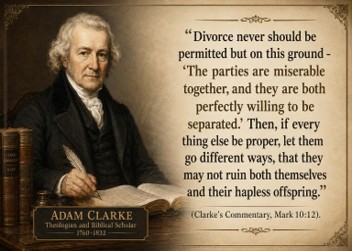 Therefore, in Mark 10:11-12, the Greek describes the two-step process (i.e., the combined act) of dismissing one’s spouse and (kai) marrying another. According to this understanding, the issue is if the man or woman is having an affair and desires to put away their spouse in order to marry the one they are having an affair with. The paraphrases I provided fit the grammar and the historical context of the Hillel-Shammai debate because Jesus is condemning the practice of discarding one spouse to obtain another, not discussing every possible circumstance in which spouses may separate. The adultery is thus tied to remarriage after an illegitimate putting away (in order to obtain another wife/husband), not merely to the act of putting away. It is clear that Jesus taught against marrying the put away woman, not the properly divorced woman!
Remember, a biblical marriage is not a vow but a covenant between the husband and wife. Anything outside the parameters of what is listed above breaks the marriage covenant. Wives are NOT expected to stay in a marriage if the husband is treating her harshly and vice versa. If the covenant is broken, the marriage is void.
- Romans 7:2-3
Before one objects to this, this does not go against Paul’s teaching in Romans 7 where he states:
“… when a woman marries, the law binds her to her husband as long as he is alive. But if he dies, the laws of marriage no longer apply to her. So while her husband is alive, she would be committing adultery if she married another man. But if her husband dies, she is free from that law and does not commit adultery when she remarries.” (Romans 7:2-3, NLT)
This is specifically talking about MARRIED couples, not divorced couples. The woman would not be committing adultery if she married another man after her and her first husband were divorced. Furthermore, in verse 1 Paul begins by saying, “Now, dear brothers and sisters—you who are familiar with the Law.” Those who knew the Law would have already been familiar with what the Law said concerning putting away and divorce, so they would not have been confused at what Paul was teaching. Yes, a woman is bound to her HUSBAND as long as he lives. However, if she possesses a bill of divorcement she would no longer have a husband. Therefore, if he is no longer her husband, she is free to remarry, regardless of whether her first husband is still alive. There are many legally divorced people in despair believing they cannot remarry until their ex-spouse either has sexual relations with someone else (believing that would be adultery) or dies. Would this not cause the lonely to rejoice when their ex either sins or dies? I pray that you too now know the Law a little better by reading this article so you will instead rejoice in God’s provision for your liberty!
- 1 Corinthians 7:10-11
It also does not conflict with what Paul teaches concerning a spouse who abandons their marriage:
“But for those who are married, I have a command that comes not from me, but from the Lord. A wife must not leave her husband. But if she does leave him, let her remain single or else be reconciled to him. And the husband must not leave his wife.” (1 Corinthians 7:10-11, NLT)
Here again Paul is not giving a blanket rule that all divorced couples must remain single until their former spouse dies. Paul is not explicitly discussing adultery, abandonment, violence, or some other grave covenant violation. His basic instruction is: Do not dissolve or abandon a marriage merely because you want out (i.e., for arbitrary reasons). In other words, he’s speaking about leaving a faithful and loving spouse, not one who has violated the marriage covenant.
In his paraphrase New Testament, called The Remedy, Dr. Tim Jennings explains these verses this way:
“To the married, the Lord has given this instruction: A wife must not leave her faithful and loving husband. But if she does, she must live as a single person — unmarried — or else be reunited with her husband. And a husband must not divorce a faithful and loving wife.” (1 Corinthians 7:10-11)
If a spouse nevertheless separates under circumstances where the marriage covenant remains intact, that separation doesn’t automatically make either person free to marry someone else. Hence: Remain unmarried or be reconciled.
On 1 Corinthians 7:10, the Pulpit Commentary says that Jesus' exception for sexual immorality is assumed by Paul, rather than abolished:
“The exception of divorce being permissible in case of fornication is assumed (Matthew 5:32; Matthew 19:9).”
Then on verse 11 it becomes even more explicit:
“The reference throughout the verse is to separation due to incompatibility of temper, etc.; not to legal divorce.”
Paul's “let her remain unmarried, or be reconciled” is not addressing the innocent spouse divorcing because the other spouse has committed sexual immorality (or some other marriage covenant violation). Paul is discussing a separation for lesser reasons while the marriage remains intact.
David Guzik correctly puts the passage into the ascetic controversy running throughout 1 Corinthians 7. He writes:
“The Corinthian Christians wondered if it might be more spiritual to be single, and if they should break up existing marriages for the cause of greater holiness.” (Guzik's Enduring Word Commentary, 1 Corinthians 7)
So, what Paul is saying is: Two Christians are married, one concludes celibacy is spiritually superior, therefore that spouse wants out, Paul says don't leave your spouse. But if that person nevertheless does leave, Paul says: “Remain unmarried or be reconciled.”
Ellicott similarly understands the background as Christians questioning marriage itself:
“1 Corinthians 7:10-11 gives his advice to those married persons who had been troubled with doubts as to whether they ought (if marriage were undesirable) to continue in that state.” (Ellicott’s Commentary, 1 Corinthians 7)
Therefore, Paul's instruction that the separating spouse “remain unmarried or be reconciled” should not automatically be applied to an innocent spouse whose marriage has been violated on grounds Scripture recognizes.
What Paul IS saying:
“If the marriage covenant remains intact, don't abandon your spouse for another relationship. If you separate without legitimate dissolution of the marriage, remain unmarried and seek reconciliation.”
What Paul ISN’T saying:
“Even when the other spouse has fundamentally repudiated and broken the marriage covenant through sexual unfaithfulness, abandonment, abuse, violence, habitual lying and deception, etc., the innocent spouse remains permanently prohibited from remarriage.”
- 1 Timothy 3:2
Nor does this conflict with what Paul teaches concerning the overseer of the assembly and how they must be “a husband of one wife” (1 Timothy 3:2, KJV). Many wrongly conclude that this means the overseer must only possess one wife throughout his lifetime and would be disqualified from the position if he were ever remarried. However, the Greek phrase, μία γυνή ἀνήρ (mia gynaikos andra) literally means “one-woman man” and is an idiom meaning “monogamous” or married and faithful to one person at a time. Paul’s emphasis is that the man is (or has been) faithful to one’s marriage, having eyes for only one woman at a time, which is exactly what Jesus meant when He cautioned any husband who “looks at a woman lustfully has already committed adultery with her in his heart” (Matthew 5:28).
“In this interpretation, a man could have been freed through death or divorce to marry seven women – one at a time and would have been considered faithful to them all. That man would be a ‘one-woman man’ because he was faithful to the one wife he had at any given time. Conversely, if the view that the ‘husband of one wife’ means that an overseer may never remarry is true, then technically he may be a skirt-chasing flirt and still be the ‘husband of one wife.’ But we can all understand that misses the obvious spirit of the passage … It is a much greater qualification to demand that the church leaders be a ‘one-woman man’ than simply to just have one wife forever. Because what we require from church leaders is that they be faithful and of a good character. If a man is only married once, but constantly lives on the edge of unfaithfulness by flirting with women (married and single) under his leadership, then he is not a ‘one-woman man’ … There are more subtle ways that we pastors can cross relationship lines with women in our churches. It would be wrong of me to pull consciously on the affections of the wives of this church away from their husbands. It is inappropriate to create a conflict of loyalty between myself and your husband – especially a godly husband. If a church leader crosses emotional lines, then he is not a ‘one-woman man.’ As your pastor, I love every person in this congregation, but there are lines that I do not cross in showing that love. When I remarry, I want my future wife to be confident that I will be a one-woman man. She needs to know I will not be chasing other women and/or their affections. She needs to know that I will have a heart only for her.” (John C. Carroll, An Introduction to Divorce & Remarriage, A Biblical Theology of Healing after Heartbreak, pp. 102-104)

In all that we have learned, this doesn’t mean there can’t be true reconciliation and healing within a bad marriage, but in mercy God gave us sinful humans the ability to remove ourselves from a bad marriage. Yes, the putting away and divorce were “not so from the beginning” as Jesus declared, but marriage was from the beginning; it is God’s design.
- Matthew 19:6
Jesus taught, “What God has joined together, let not man separate” (Matthew 19:6). Again, this passage is misunderstood to mean that marriage is permanent and unbreakable, however, Jesus is NOT saying “man CANNOT separate”, He’s saying, “do not separate” or in other words, although marriage is breakable, “you should not.” Ideally, marriage should not be broken, but when the marriage covenant has been broken beyond repair, God has given sinful man redemption from this brokenness, which often includes divorce and remarriage. God has the ability and grace to forgive us our sins and to cleanse us from all unrighteousness and lead us into a remarriage covenant where the man and the woman will, by His grace, have His Law written in their hearts and minds. Thus, there will be no more putting away your spouse for any frivolous thing, for both will selflessly love and cherish one another as God designed.
“Divorce was not so from the beginning, but marriage and multiplication of offspring were (Genesis 1.28). If divorce always prevents all parties from remarrying, then divorce trumps marriage. If divorce always prevents all parties from remarrying, then divorce is a higher law than marriage. If divorce always prevents all parties from remarrying, then the fall has triumphed over creation. If divorce always prevents all parties from remarrying, then sin is more powerful than redemption. Therefore, redemption in a fallen world refuses to make what was so from the beginning (marriage and multiplication) slave to what was not so from the beginning (divorce).” (John C. Carroll, An Introduction to Divorce & Remarriage, A Biblical Theology of Healing after Heartbreak, p. 114)